 Cozy Critter
Most toddlers who wake at 5am are responding to early light, an early bedtime, or a body clock that has drifted early. In 2026, first light comes before 5:30am on 143 days in London and 103 in New York. Black out the room, keep wake time fixed, and show the child when morning starts.
Toddlers wake at 5am mostly because something tells the body clock that morning has arrived: daylight at the window, a bedtime early enough that the night's sleep is finished, or a schedule that has slid earlier. Light is the one factor parents can measure. We calculated first light, known as civil dawn, for every day of 2026 in 23 cities using the NOAA solar equations, and they show how much earlier daylight reaches the bedroom between April and August.
What time does it get light in my city?
Civil dawn, when the sun sits 6 degrees below the horizon and outdoor light is enough to see by, comes before 6:00am on 188 days of 2026 in London and 157 days in New York. Edinburgh gets first light at 3:24am in June. In Miami, first light never comes before 6:00am.
| City | Country | Earliest first light | Earliest sunrise | Days first light before 6:00 | Days before 5:30 |
|---|---|---|---|---|---|
| London | UK | 3:55 a.m. | 4:43 a.m. | 188 | 143 |
| Edinburgh | UK | 3:24 a.m. | 4:26 a.m. | 178 | 141 |
| Manchester | UK | 3:47 a.m. | 4:39 a.m. | 179 | 139 |
| Phoenix | US | 4:49 a.m. | 5:18 a.m. | 192 | 128 |
| Boston | US | 4:32 a.m. | 5:07 a.m. | 193 | 127 |
| Chicago | US | 4:40 a.m. | 5:15 a.m. | 176 | 117 |
| Dublin | Ireland | 4:04 a.m. | 4:56 a.m. | 156 | 117 |
| Vancouver | Canada | 4:23 a.m. | 5:06 a.m. | 148 | 114 |
| Seattle | US | 4:30 a.m. | 5:11 a.m. | 148 | 111 |
| New York | US | 4:51 a.m. | 5:24 a.m. | 157 | 103 |
| Minneapolis | US | 4:48 a.m. | 5:26 a.m. | 137 | 96 |
| Denver | US | 4:59 a.m. | 5:31 a.m. | 145 | 93 |
| Sydney | Australia | 5:05 a.m. | 5:30 a.m. | 190 | 93 |
| Toronto | Canada | 4:59 a.m. | 5:35 a.m. | 127 | 83 |
| Los Angeles | US | 5:12 a.m. | 5:41 a.m. | 166 | 76 |
| Washington, DC | US | 5:10 a.m. | 5:42 a.m. | 126 | 72 |
| San Francisco | US | 5:16 a.m. | 5:47 a.m. | 119 | 61 |
| Melbourne | Australia | 5:20 a.m. | 5:51 a.m. | 121 | 47 |
| Auckland | New Zealand | 5:24 a.m. | 5:55 a.m. | 109 | 35 |
| Atlanta | US | 5:57 a.m. | 6:26 a.m. | 27 | 0 |
| Miami | US | 6:03 a.m. | 6:29 a.m. | 0 | 0 |
| Dallas | US | 5:50 a.m. | 6:19 a.m. | 56 | 0 |
| Houston | US | 5:53 a.m. | 6:20 a.m. | 49 | 0 |
Latitude drives most of the spread. Edinburgh, Manchester and London sit between 51 and 56 degrees north, so their June nights are short and first light arrives before 4:00am. Houston, Dallas and Miami sit below 33 degrees north and never see first light before 5:30am. Phoenix is a special case: Arizona does not use daylight saving time, so its summer first light lands at 4:49am by the clock, earlier than Chicago.
| City | Jan | Feb | Mar | Apr | May | Jun | Jul | Aug | Sep | Oct | Nov | Dec |
|---|---|---|---|---|---|---|---|---|---|---|---|---|
| New York | 6:45 | 6:14 | 6:30 | 5:39 | 5:02 | 4:52 | 5:11 | 5:43 | 6:15 | 6:46 | 6:20 | 6:46 |
| Boston | 6:37 | 6:03 | 6:18 | 5:24 | 4:44 | 4:33 | 4:53 | 5:28 | 6:03 | 6:36 | 6:12 | 6:38 |
| Washington, DC | 6:54 | 6:25 | 6:43 | 5:55 | 5:20 | 5:11 | 5:29 | 5:59 | 6:28 | 6:57 | 6:29 | 6:53 |
| Atlanta | 7:14 | 6:50 | 7:15 | 6:34 | 6:05 | 5:58 | 6:14 | 6:38 | 7:00 | 7:22 | 6:48 | 7:11 |
| Miami | 6:44 | 6:28 | 7:01 | 6:28 | 6:07 | 6:04 | 6:17 | 6:33 | 6:46 | 6:59 | 6:18 | 6:38 |
| Chicago | 6:42 | 6:09 | 6:24 | 5:31 | 4:52 | 4:41 | 5:01 | 5:36 | 6:09 | 6:42 | 6:17 | 6:43 |
| Minneapolis | 7:11 | 6:34 | 6:45 | 5:47 | 5:03 | 4:49 | 5:12 | 5:51 | 6:30 | 7:07 | 6:46 | 7:14 |
| Dallas | 7:01 | 6:39 | 7:05 | 6:25 | 5:57 | 5:51 | 6:06 | 6:29 | 6:50 | 7:11 | 6:36 | 6:58 |
| Houston | 6:51 | 6:31 | 7:00 | 6:24 | 5:59 | 5:54 | 6:08 | 6:28 | 6:46 | 7:03 | 6:26 | 6:46 |
| Denver | 6:47 | 6:17 | 6:35 | 5:45 | 5:09 | 4:59 | 5:18 | 5:49 | 6:20 | 6:49 | 6:22 | 6:47 |
| Phoenix | 7:04 | 6:41 | 6:06 | 5:25 | 4:56 | 4:50 | 5:06 | 5:29 | 5:51 | 6:13 | 6:39 | 7:01 |
| Los Angeles | 6:29 | 6:06 | 6:30 | 5:48 | 5:19 | 5:13 | 5:29 | 5:53 | 6:16 | 6:38 | 6:04 | 6:27 |
| San Francisco | 6:53 | 6:25 | 6:45 | 5:59 | 5:25 | 5:17 | 5:34 | 6:03 | 6:31 | 6:57 | 6:28 | 6:52 |
| Seattle | 7:14 | 6:33 | 6:39 | 5:36 | 4:47 | 4:31 | 4:56 | 5:40 | 6:24 | 7:06 | 6:49 | 7:19 |
| Toronto | 7:13 | 6:38 | 6:50 | 5:54 | 5:13 | 5:00 | 5:21 | 5:58 | 6:35 | 7:10 | 6:48 | 7:15 |
| Vancouver | 7:21 | 6:38 | 6:41 | 5:34 | 4:42 | 4:23 | 4:50 | 5:39 | 6:26 | 7:11 | 7:57 | 8:27 |
| London | 7:16 | 6:29 | 5:28 | 5:16 | 4:18 | 3:55 | 4:25 | 5:19 | 6:11 | 7:00 | 6:51 | 7:23 |
| Manchester | 7:30 | 6:39 | 5:34 | 5:17 | 4:13 | 3:47 | 4:20 | 5:20 | 6:18 | 7:11 | 7:05 | 7:40 |
| Edinburgh | 7:43 | 6:46 | 5:35 | 5:11 | 3:58 | 3:24 | 4:04 | 5:14 | 6:19 | 7:18 | 7:18 | 7:55 |
| Dublin | 7:46 | 6:55 | 5:51 | 5:34 | 4:30 | 4:04 | 4:37 | 5:37 | 6:34 | 7:27 | 7:21 | 7:55 |
| Sydney | 5:37 | 6:10 | 6:34 | 5:56 | 6:17 | 6:32 | 6:28 | 6:02 | 5:22 | 5:41 | 5:13 | 5:11 |
| Melbourne | 5:51 | 6:28 | 6:57 | 6:25 | 6:50 | 7:06 | 7:01 | 6:31 | 5:46 | 6:00 | 5:26 | 5:23 |
| Auckland | 5:55 | 6:31 | 6:58 | 6:25 | 6:49 | 7:05 | 7:00 | 6:31 | 5:47 | 6:03 | 5:30 | 5:27 |
before 5:005:00 to 5:596:00 to 6:29
Method: NOAA solar position equations, sun at 6 degrees below the horizon (civil dawn) and 0.833 degrees (sunrise), city-center coordinates, local clock time from the IANA time zone database, including British Columbia's move to permanent daylight time in 2026. Results agree with published almanac times to within about a minute.
Why does early morning light wake toddlers up?
Light is the strongest signal the human body clock uses to set its timing, and young children respond to it strongly. In a University of Colorado Boulder lab study, one hour of bright light before bed cut preschoolers' melatonin by 87.6 percent, and a follow-up found that dim light of 5 to 40 lux still cut it by 77.5 percent.
Melatonin is the hormone that rises in the evening and signals night to the body. LeBourgeois and colleagues (2013, Journal of Biological Rhythms) measured it in 45 toddlers aged 30 to 36 months. Melatonin rose at 7:29pm on average, about 11.3 hours before the children woke, and toddlers whose melatonin rose later also woke later. The average wake time in that group was 6:44am.
The light studies, Akacem et al. (2018, Physiological Reports) and Hartstein et al. (2022, Journal of Pineal Research), tested evening light, not dawn. The morning side comes from adult research: Khalsa et al. (2003, Journal of Physiology) mapped how light at different hours shifts the body clock, and light shortly after the body's biological night ends moves the clock earlier. No study has yet measured dawn light in toddlers' bedrooms, so the link to 5am waking is a strong inference rather than a tested result.
Why does my toddler wake up earlier after clocks change?
Clock changes move the family schedule by an hour overnight, while a toddler's body clock adjusts by only a few minutes a day. After the UK falls back on October 25, 2026 and most of North America on November 1, 2026, a child who woke at 6:30am will tend to wake around 5:30am by the new clock.
The fall change also moves first light an hour earlier on the clock overnight. In New York, first light goes from 6:57am on October 31 to 5:58am on November 1. In London it goes from 7:05am on October 24 to 6:07am on October 25. A room that was dark at 6:00am one week is grey at 6:00am the next.
| Region | Clocks go forward | Clocks go back |
|---|---|---|
| Most of the US and Canada | March 8 | November 1 |
| UK and Ireland | March 29 | October 25 |
| Sydney and Melbourne | October 4 | April 5 |
| Auckland | September 27 | April 5 |
| Arizona (Phoenix) | No change | No change |
| British Columbia (Vancouver) | March 8 | No change: permanent daylight time from 2026 |
Two approaches work for most families. Move bedtime and wake time 10 to 15 minutes later each day across the week before the change, so the child arrives on the new clock already adjusted. Or leave the child alone and move the wake signal instead: set the wake time an hour early on the first morning and walk it back in 10-minute steps over 6 days. The second approach keeps the rule "stay in bed until the clock says so" intact, because the clock never asks the child to wait longer than the body allows.
Clock change dates: IANA time zone database, release 2026e.
How many hours of sleep does a toddler need?
The American Academy of Sleep Medicine, in guidance endorsed by the American Academy of Pediatrics, recommends 11 to 14 hours in every 24 for children aged 1 to 2 and 10 to 13 hours for ages 3 to 5, naps included. A two-year-old asleep by 6:30pm with a long nap may have finished a full night by 5am.
Do the arithmetic before treating 5am as a problem. A two-year-old asleep at 7:00pm who wakes at 5:00am has slept 10 hours. Add a 2-hour nap and the total is 12 hours, inside the recommended range from Paruthi et al. (2016, Journal of Clinical Sleep Medicine). That child has slept enough, only early. Moving bedtime later in 15-minute steps every 3 or 4 nights, or trimming the nap, moves the morning with it.
Naps fade on their own over the preschool years. A 2020 meta-analysis in Sleep Medicine Reviews (Staton et al.) found that 33 percent of children had stopped napping by age 3, 57 percent by age 4 and 80 percent by age 5, with wide variation between studies. A child who naps long and wakes early is often a child getting ready to drop the nap.
What can parents change to stop 5am wake-ups?
Five changes cover the causes parents control: block window light fully before first light, keep any night light dim and warm, hold the wake time steady every day of the week, move bedtime later in 15-minute steps if total sleep is above the recommended range, and give the child a visible signal for when getting up is allowed.
- Black out the room before first light. Stand in it at the first-light time for your city in the table above. If you can read a book by the window, the blind is not doing its job. Seal the edges, because light leaks at the sides and top.
- Keep night lights dim and warm. In a small 2025 study in the Journal of Biological Rhythms (Hartstein et al., 10 children), 20 lux of cool 5000 K light suppressed preschoolers' melatonin by 56.3 percent against 23.9 percent for warm 2700 K light.
- Fix the wake time, weekends included. A consistent morning anchors the body clock, and a toddler's clock does not move for a parent's sleep-in.
- Set bedtime from total sleep, using the ranges above. Early bedtime is good advice for an overtired child and poor advice for one who already sleeps 13 hours.
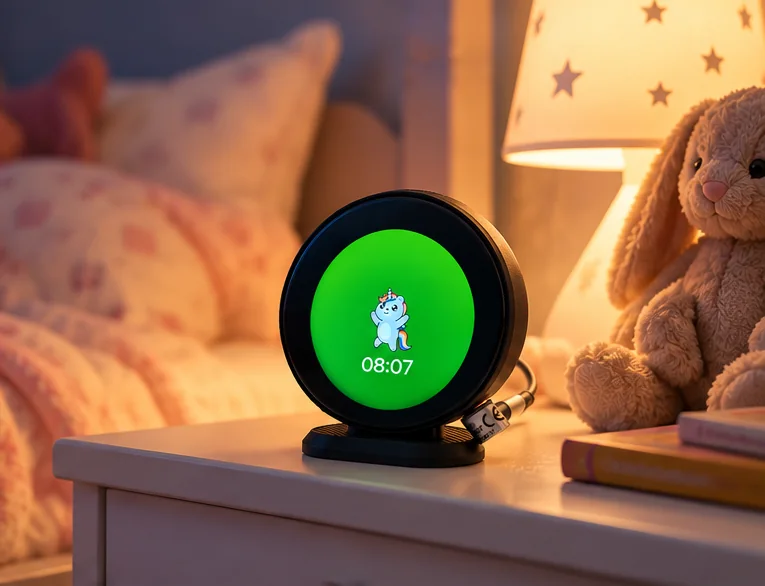
- Give the child a signal to read. Toddlers cannot read clock digits, so 5:10am and 6:50am look the same. A wake clock that changes picture or color turns "not yet" into something visible.

The research on wake clocks themselves is thin. Behavioral sleep treatments as a group have strong support: an American Academy of Sleep Medicine review (Mindell et al., 2006) found 94 percent of 52 studies reported them effective. No controlled trial has isolated the clock, though. The closest study, a 2025 single-case series in the Journal of Autism and Developmental Disorders, used a Gro-clock alongside schedule changes in children with neurodevelopmental conditions, and parents described the clock as giving their children autonomy.
Key takeaways
- First light comes before 5:30am on 143 days a year in London and 103 in New York, so summer early waking is often light.
- Toddlers' melatonin rises about 11 hours before they wake, and light is the main signal that sets when that happens.
- After clocks fall back, a 6:30am waker tends to wake at 5:30am, and first light jumps an hour earlier on the clock.
- Check total sleep against the 11 to 14 hour range for ages 1 to 2 before treating 5am as a problem.
- Blackout, a fixed wake time and a visible wake signal address the causes parents can control.
Frequently asked questions
Is it normal for a toddler to wake at 5am?
Waking at 5am is common in toddlers and is not a medical problem by itself. Check total sleep first: children aged 1 to 2 need 11 to 14 hours in every 24, naps included. A toddler who sleeps enough but wakes early usually has an early bedtime, a light room or a body clock that has drifted early.
Do blackout curtains help toddlers sleep later?
Blackout curtains help when early light is reaching the room before the child's wake time. In London, first light comes before 5:30am on 143 days of 2026. Curtains need to seal at the edges and top, since light leaking around a blind is often enough to brighten the room at dawn.
Why does my toddler wake up earlier when the clocks go back?
The clocks move an hour overnight but a toddler's body clock moves only a few minutes a day. A child used to waking at 6:30am will wake near 5:30am by the new time. Shift the schedule in 10 to 15 minute steps over a week, before or after the change.
Should I put my toddler to bed later to stop early waking?
A later bedtime helps only when the toddler's total sleep is above the recommended range: 11 to 14 hours for ages 1 to 2, 10 to 13 hours for ages 3 to 5. Move bedtime 15 minutes later every 3 or 4 nights. An overtired child who already sleeps too little needs the opposite.
At what age can a toddler use an OK-to-wake clock?
Most families start an OK-to-wake clock between ages 2 and 3, when a child can follow a simple rule such as staying in bed until the picture changes. Clocks that show a picture or color work before a child can read digits. Start with a wake time close to when the child already wakes.