 Cozy Critter
How do I teach my toddler to stay in bed until morning?
Last updated · By the Cozy Critter team
Teach a toddler to stay in bed with a consistent routine, a visible signal for when morning starts, and calm, brief returns to bed. Behavioral methods worked in 94 percent of 52 studies in an American Academy of Sleep Medicine review. Start the wake signal at the child's current wake time and move it later in 10-minute steps.
Toddlers stay in bed when the rule is simple, visible and the same every night. Between 20 and 30 percent of infants, toddlers and preschoolers have bedtime problems or night waking, according to the American Academy of Sleep Medicine review of behavioral treatments, and the same review found that structured behavioral methods help most of them. The plan below combines those methods with a wake clock, so the child can see when getting up is allowed instead of asking.
What actually works to keep a toddler in bed?
Behavioral methods work for most toddlers who leave their bed. An American Academy of Sleep Medicine review by Jodi Mindell and colleagues in 2006 found that 94 percent of 52 studies reported these methods effective, and over 80 percent of treated children improved and kept the gains for 3 to 6 months.
The methods in that review share three features. The bedtime routine is the same every night. Leaving bed earns nothing interesting: no conversation, no extra story, no screen. Staying in bed earns attention and praise. Methods differ in how fast parents withdraw their presence, and families can pick the pace they can sustain.
- The same routine every night: bath, teeth, two books, lights out, in that order and at that time.
- Graduated withdrawal, where a parent sits by the bed and moves the chair toward the door over several nights.
- Silent returns: a child who gets up is walked back with as few words as possible, every time.
- A morning reward, such as a sticker or a special breakfast job, for a night spent in bed, given as soon as the child wakes.
Consistency matters more than which method a family picks. A rule enforced on four nights out of seven teaches a toddler that leaving bed sometimes pays, and intermittent rewards keep a behavior going longer than constant ones.
How does the bedtime pass work for toddlers?
The bedtime pass is a card a child can trade for one free trip out of bed each night, for a hug or a drink. In a 2007 randomized trial of 19 children aged 3 to 6, children given the pass left the room and called out significantly less than controls, and the gains held at 3 months.
The pass was described by Patrick Friman and colleagues in 1999 (Archives of Pediatrics and Adolescent Medicine). Moore, Friman and colleagues (2007, Journal of Pediatric Psychology) then ran the randomized trial. Parents rated the pass as highly acceptable, and there was no extinction burst, the temporary spike in crying that often follows ignoring a behavior.
Freeman (2006, Journal of Applied Behavior Analysis) tested the pass with four three-year-olds and found that bedtime resistance stopped in all four. The likely reason it works: the child gets a little control, so there is less to gain from testing the rule. It pairs well with a wake clock: the pass covers the evening, the clock covers the early morning.
How do you introduce an OK-to-wake clock?
Introduce an OK-to-wake clock at the child's current wake time, not the target. If the child wakes at 5:30am, set the clock to 5:30am so the first mornings are easy wins, then move the wake time 10 minutes later every few days until it reaches the time the family wants.
A common mistake is starting at the target wake time. A child asked to wait an hour on the first morning fails, and learns that the clock's rule is impossible. A child asked to wait no time at all succeeds, gets praised, and starts to trust the signal. This is shaping: reinforcing small steps toward a target, a standard technique in applied behavior analysis.
| Stage | Wake time | Bedtime | Morning |
|---|---|---|---|
| Nights 1 to 3 | Set wake time to when the child already wakes, even if that is 5:30am | Show the clock at bedtime: "When the critter wakes up, you can get up." | Praise the moment the screen changes and get up together straight away |
| Nights 4 to 7 | Move wake time 10 minutes later | Same words, same routine | Praise every morning the child waited, even for a minute |
| Week 2 | Move 10 minutes later every 2 or 3 mornings | Keep the bedtime routine identical | If the child gets up early, a calm walk back to bed with no conversation |
| Week 3 onward | Stop at the target wake time | Use the transition stage, if the clock has one, to show morning is near | Hold the rule on weekends and on vacation |

No controlled trial has tested a wake clock on its own in typically developing children. The plan above is clinical practice built on the behavioral principles in the studies cited here, not a tested protocol. Expect to adjust the pace to the child.
What should you do when a toddler gets up early?
When a toddler gets up before the wake signal, walk the child back to bed calmly, say one short line such as "The critter is still sleeping", and leave. Repeat it the same way every time. A long conversation, a cuddle in the parents' bed or a screen teaches the child that getting up early works.
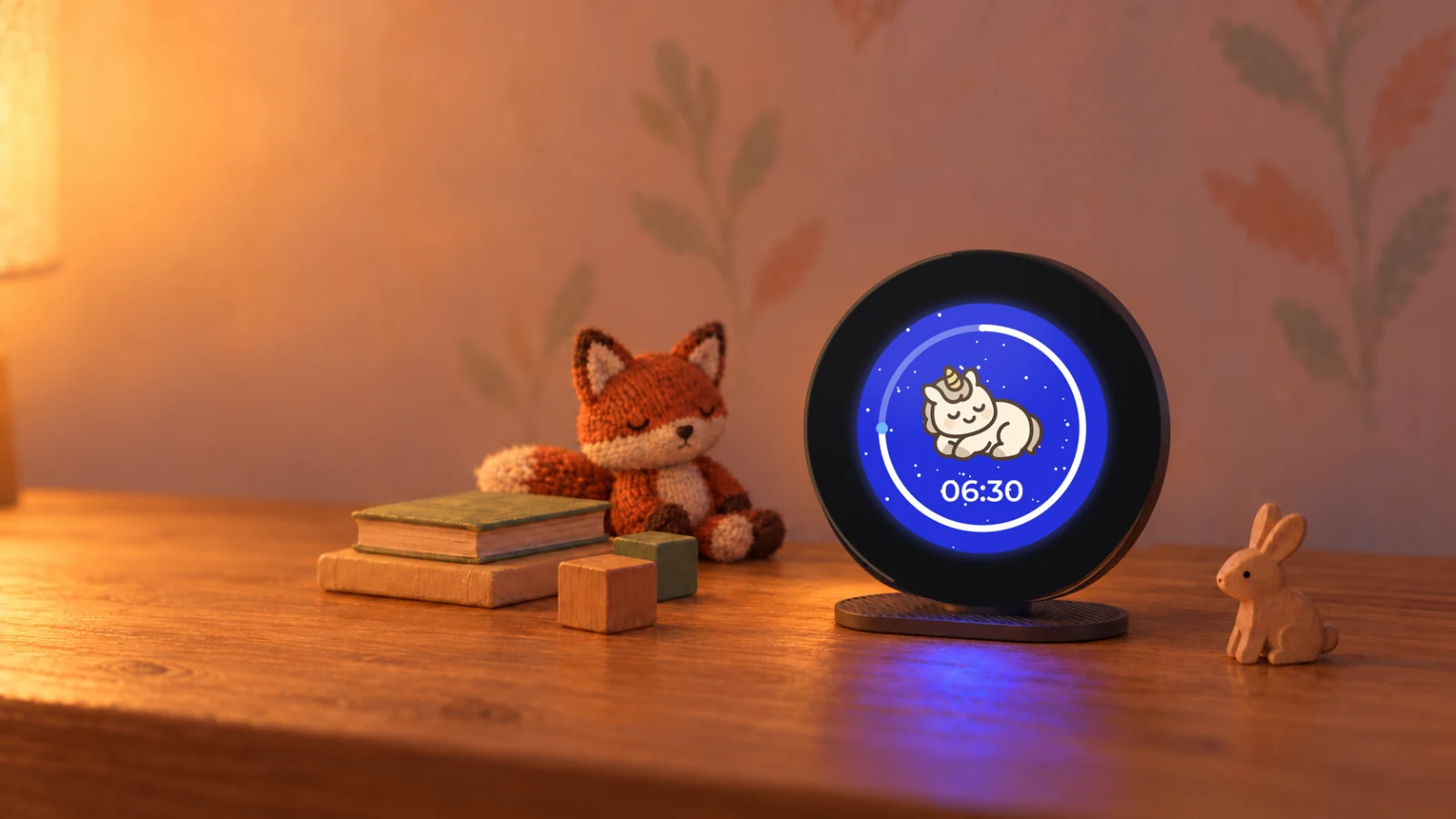
Point to the clock instead of arguing. A visible signal means the rule belongs to the clock, not to the parent, so there is nothing to negotiate. If the clock has a pre-wake stage, such as a color change or a ring that fills, use it to show the child how close morning is: "Look, the ring is nearly closed. Back to bed until the critter wakes up."
Early mornings after illness, travel or a clock change are expected. Move the wake time back to where the child can succeed for a few days, then step it forward again. Holding the old target through a disrupted week produces a string of failures that undo the progress.
When is leaving bed a sign of something else?
Frequent night waking, loud snoring, pauses in breathing or daytime sleepiness can point to a medical cause such as obstructive sleep apnea. The American Academy of Pediatrics recommends that clinicians ask about snoring at routine visits, and a child who snores most nights should see a pediatrician before any behavioral plan starts.
The American Academy of Pediatrics clinical practice guideline (Marcus et al., 2012, Pediatrics) covers obstructive sleep apnea in children. Restless sleep, sweating at night, mouth breathing and new bedwetting are other signs worth raising. Behavioral plans work on habits; they cannot fix a breathing problem, and a child who wakes because breathing is hard should not be asked to wait for a clock.
Fear is the other common cause. A child who has started leaving bed after a frightening event, a move or a new sibling may need a parent nearby for a while. Graduated withdrawal, with a parent sitting close and moving away over several nights, suits that child better than silent returns.
Key takeaways
- Behavioral sleep methods worked in 94 percent of 52 studies in the American Academy of Sleep Medicine review.
- The bedtime pass reduced leaving the room in a randomized trial of children aged 3 to 6, with gains holding at 3 months.
- Start a wake clock at the time the child already wakes, then move it later in 10-minute steps.
- Walk an early riser back to bed with one short line, the same way every time.
- Snoring most nights or pauses in breathing need a pediatrician before any behavioral plan.
Frequently asked questions
How long does it take a toddler to learn to stay in bed?
There is no fixed timeline, but in the American Academy of Sleep Medicine review over 80 percent of treated children improved and kept the gains for 3 to 6 months. A wake clock started at the current wake time and moved 10 minutes later every 2 or 3 days reaches a 60-minute shift in about three weeks.
What if my toddler keeps getting out of bed after I put them back?
Keep walking the child back with the same short line and no conversation, as many times as it takes. Return trips usually rise for a night or two and then fall. Giving in after the tenth return teaches the child that ten returns work, which makes the next night harder.
Should I lock my toddler's bedroom door?
Locking a toddler's door is not recommended because it blocks a quick exit in an emergency such as a fire. A safety gate at the doorway is the common alternative, with the room fully childproofed: furniture anchored to the wall, cords out of reach and window locks fitted.
Is it too late to start an OK-to-wake clock at age 4?
Age 4 is a good age to start an OK-to-wake clock, because a four-year-old understands a rule tied to a picture and remembers it at 5am. Start at the child's current wake time, explain the rule at bedtime, and praise each morning the child waits for the signal.
Does a reward chart help a toddler stay in bed?
A reward chart helps when the reward comes immediately in the morning and the goal is small enough to hit on most nights. A sticker for staying in bed until the wake signal works better than a prize after a full week, which is too far away for a two- or three-year-old.